

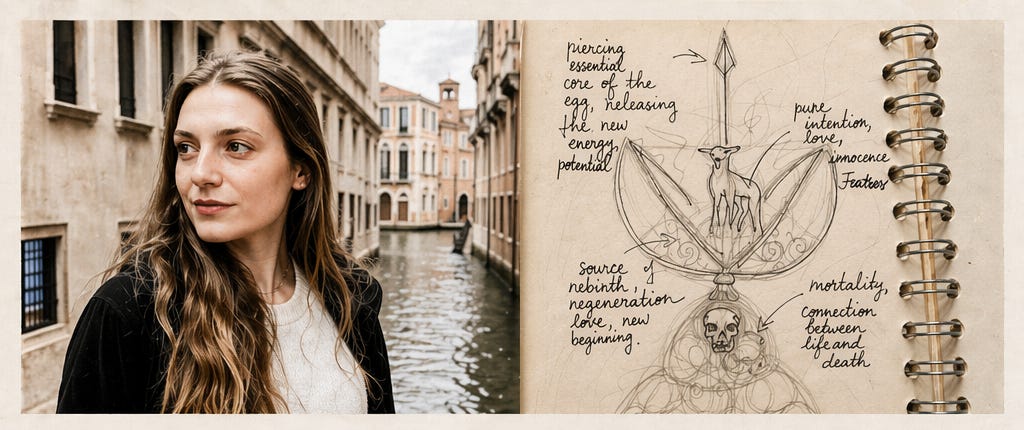
There’s something quietly extraordinary about having another artist interpret your work.
As writers, we spend hours—days, months—trying to bring something into being from nothing. Words, carefully placed, building images in the mind. But when someone else takes those words and gives them form—real, visible, tangible form—it does something unexpected. It reflects your work back to you. It shows you what you didn’t quite know you had written.
It brings the invisible into the world.
I first came across Lauma Kodola in a coffee shop that, quite simply, served the best coffee. I was a regular—laptop open, writing away—and like most Irish cafés, there was always a bit of craic, easy conversation, laughter, familiarity. I’d chat with Vera and the others behind the counter.
Lauma was different.
Quieter. More reserved. Not withdrawn, but contained. At first glance, you might have missed her entirely. But that stillness… it wasn’t absence. It was depth.
Over the weeks, I got used to seeing her there as I wrote. Then, at Christmas, she handed me a card.
Inside was a drawing.
Me.
Sitting at the table, leather jacket, hat, bent over my laptop—caught in the act of writing. It was one of those rare gifts that stop you. Not because it’s expensive or elaborate, but because it’s seen. She had observed something and captured it with a clarity I hadn’t expected.
That was the first moment I realised the level of her talent.
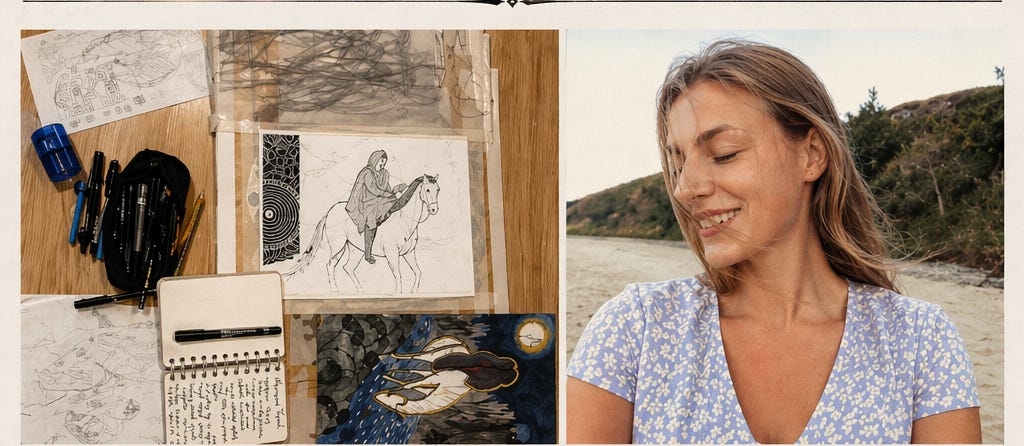
Later, when I wrote A Modern Christmas Carol, she read it and responded in the way only a true artist can—by creating. She drew a peregrine falcon from the story, an emissary figure woven into the narrative. It wasn’t just illustration. It was interpretation. She had understood something essential and given it wings.
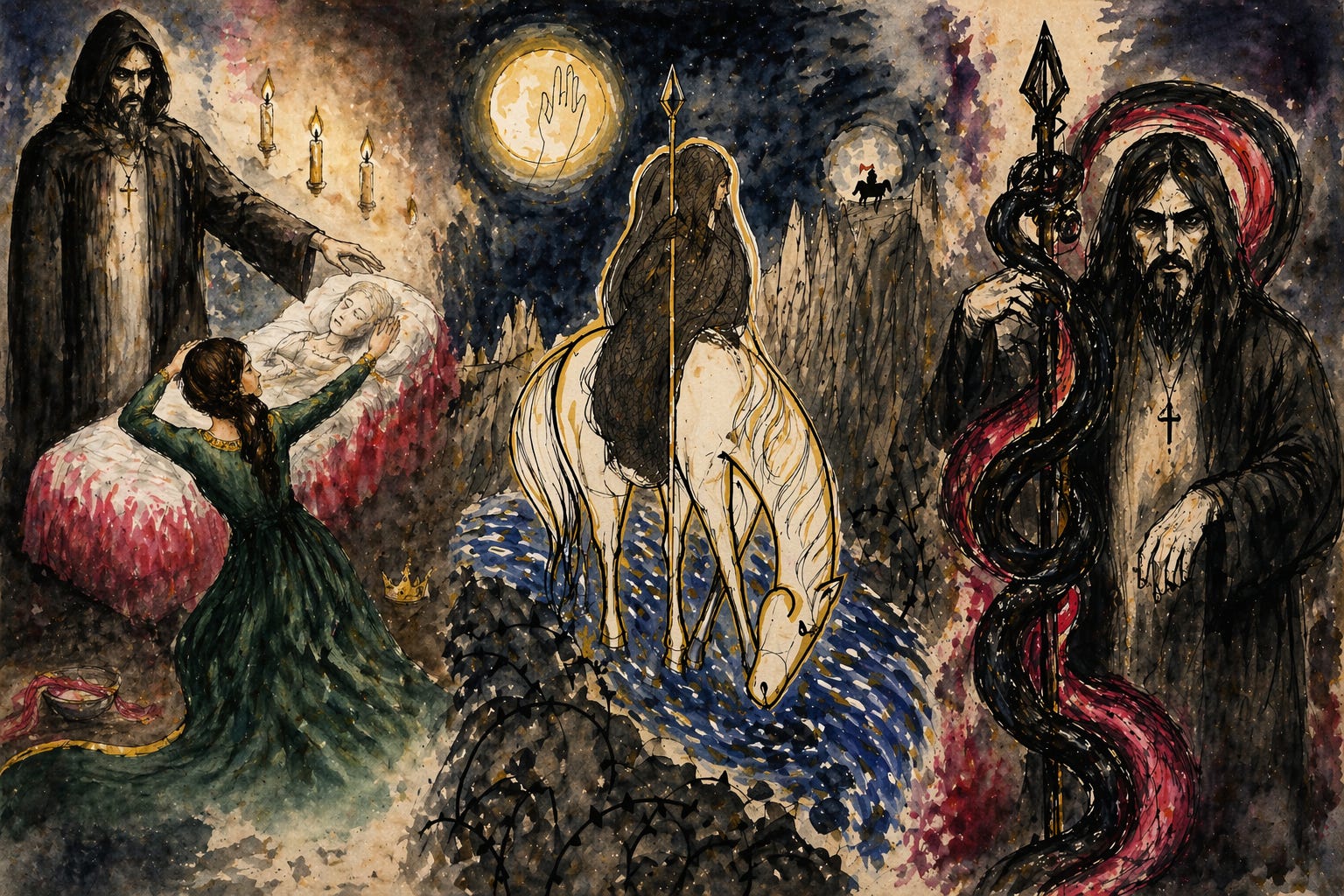
When I began The Secret of the Sacred Spear, I asked if she might be interested in reading early drafts. At first, she seemed reluctant to take on the role of translating words into images. There was no sense of ambition or self-promotion about her—no grand declaration that this would be the next big thing.
And that, in truth, is what struck me most.
There was no pretence.
No ego.
Just the work.
Then one day, we met in the National Gallery. She brought a series of drawings—laid them out quietly, almost without ceremony. And I saw it again: that same depth, that same ability to take something internal and render it with honesty and precision.
It reminded me of something often said about Johann Sebastian Bach—that he never set out to be famous. He simply worked. Fed his family. Wrote music to the best of his ability. Ad maiorem Dei gloriam—for the greater glory of something beyond himself.
There’s something of that in Lauma.
A kind of purity of intent.
She creates because she must.
And the result is work that feels… true.
Over time, I’ve introduced her to others—Erik, a very accomplished graphic designer, immediately recognised her talent. That’s the thing about genuine ability: it doesn’t need explanation. It reveals itself.
But perhaps the deeper lesson here isn’t just about art.
It’s about people.
We pass by extraordinary lives every day without noticing. The barista making your coffee. The person cleaning your gym. The quiet figure in the corner of a room. We assume we understand what we’re seeing—but we rarely do.
Everyone carries something.
An inner world. A gift. A story.
Lauma is a reminder of that.
That it’s worth looking again. Worth taking the time. Worth treating people not as roles or functions, but as equals—because they are.
In the next piece, I’ll let her speak for herself.
For now, I simply wanted to share her work—and, in some small way, help bring it into the light.
Because sometimes, the greatest gift isn’t just creating.
It’s being seen.